
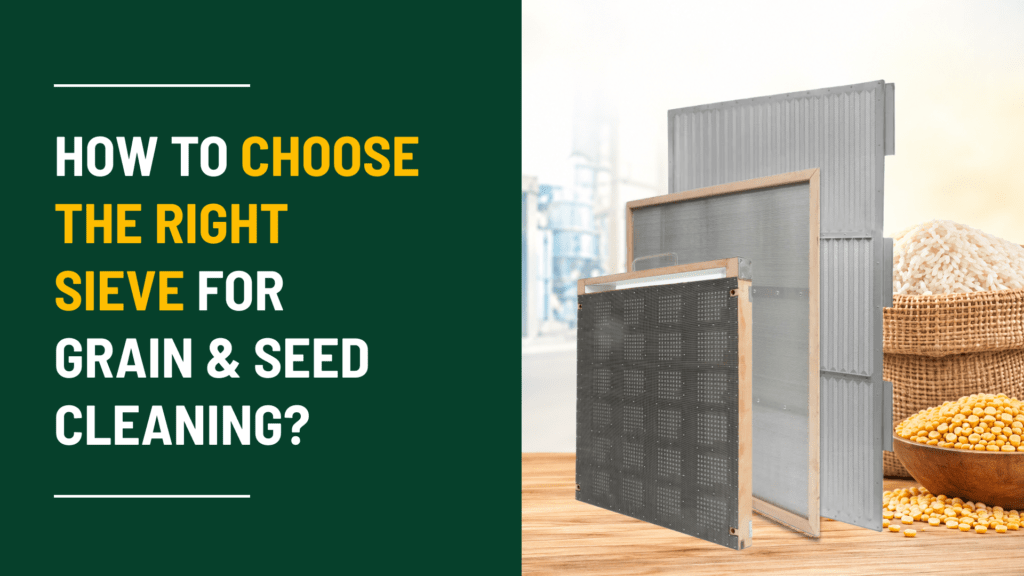
Choosing the wrong sieve is one of the most common — and most costly — mistakes in grain and seed processing. The right grain and seed cleaning machine sieves directly affect cleaning accuracy, throughput, and how much product is lost or misclassified during processing.
Since classifiers, pre-cleaners, and destoners each serve a distinct purpose, choosing the correct sieve for each stage matters just as much as the machine itself. Here’s how to make that decision correctly.
Understanding the Three Core Sieve Applications
Before selecting a sieve, it helps to understand exactly what each machine stage is designed to do — separation logic differs significantly between classification, pre-cleaning, and destoning.
1. Classifier Sieves: Sorting by Size and Shape
Classifier sieves separate grain or seed by size, length, and shape, using precisely perforated screens. Dhanlaxmi offers classifier sieves in multiple frame types, including Classifier Sieves (MTRA), Classifier PP Frames (MTRA), and wooden frame options like Classifier Wooden Frames (MTRA) and Classifier Wooden Frames (MTRB).
2. Pre-Cleaner and Fine Cleaner Sieves: Removing Bulk Impurities
Pre-cleaner sieves handle the first major separation stage, removing husk, dust, straw, and oversized debris before finer processing begins. Frame material affects durability and vibration performance, which is why options like Aluminum Profile Pre-Cleaner Sieves, Wooden Profile Pre-Cleaner Sieves, and TAS-152 Pre-Cleaner Sieves each suit different operating conditions.
3. Destoner Sieves: Separating by Density
Unlike classifiers and pre-cleaners, destoner sieves separate material based on density and specific gravity rather than size alone, making them essential for removing stones and heavy debris that are similar in size to the grain itself. A properly configured Vibro Destoner (Complete Wooden Frame) setup is critical for this stage.
Choosing the Right Sieve: Key Factors to Consider
Factor | Why It Matters |
Grain or seed type | Different crops need different perforation shapes and sizes |
Impurity type | Determines whether classifier, pre-cleaner, or destoner is the priority stage |
Frame material | Wooden, aluminum, or PP frames affect durability and vibration behaviour |
Machine model compatibility | Sieves must match your existing machine’s frame specifications |
Throughput requirements | Higher volume operations need sieves rated for sustained load |
Don’t Overlook Sampler Sieves for Quality Testing
Before scaling up production settings, Sampler Sieves allow for small-batch testing to confirm the right screen configuration before committing to full production runs.
Shifter Frame Options Also Matter
- Stainless steel wiremesh options via Shifter Frames with SS Wiremesh, for durability in high-moisture environments
- Standard configurations via Plan Shifter Frames, for general-purpose shifting applications
Working With the Right Supplier
Sieve selection is rarely a one-time decision — as crop types, seasons, and impurity profiles change, sieve configurations often need adjustment. Browsing the full product range or learning more about Dhanlaxmi Sales helps ensure long-term compatibility as your processing needs evolve.
Key Takeaways
- Classifier, pre-cleaner, and destoner sieves each serve a distinct separation purpose and shouldn’t be treated interchangeably.
- Frame material — wooden, aluminum, or PP — affects durability and vibration performance.
- Destoner sieves separate by density, not size, making them essential for stone removal.
- Sampler sieves allow small-batch testing before committing to full production settings.
- Sieve configuration often needs periodic adjustment as crop type and impurity profiles change.
Frequently Asked Questions
What’s the main difference between a classifier and a pre-cleaner sieve?
Classifier sieves sort material by size and shape, while pre-cleaner sieves focus on removing bulk impurities like husk, dust, and oversized debris early in the process.
Why does frame material matter for sieve performance?
Frame material affects vibration behaviour, durability, and how well the sieve holds up under sustained processing loads and environmental conditions.
Can the same sieve be used for different grain types?
Generally no — different grains and seeds require specific perforation sizes and shapes for accurate separation.
How often should sieves be replaced or reconfigured?
This depends on usage intensity and crop variation, but periodic review is recommended, especially with seasonal or crop-type changes.
What role does a destoner sieve play if my classifier already sorts by size?
Stones and heavy debris are often similar in size to grain, so density-based separation through a destoner is necessary to remove what size-based sorting alone cannot.
Conclusion
Choosing the right sieve isn’t just about matching a machine model — it’s about matching classifier, pre-cleaner, and destoner sieve types to your specific grain, impurity profile, and throughput needs.
Explore the complete range of sieves and frames in the Dhanlaxmi Sales product catalogue or learn more about our expertise to find the right configuration for your operation.