
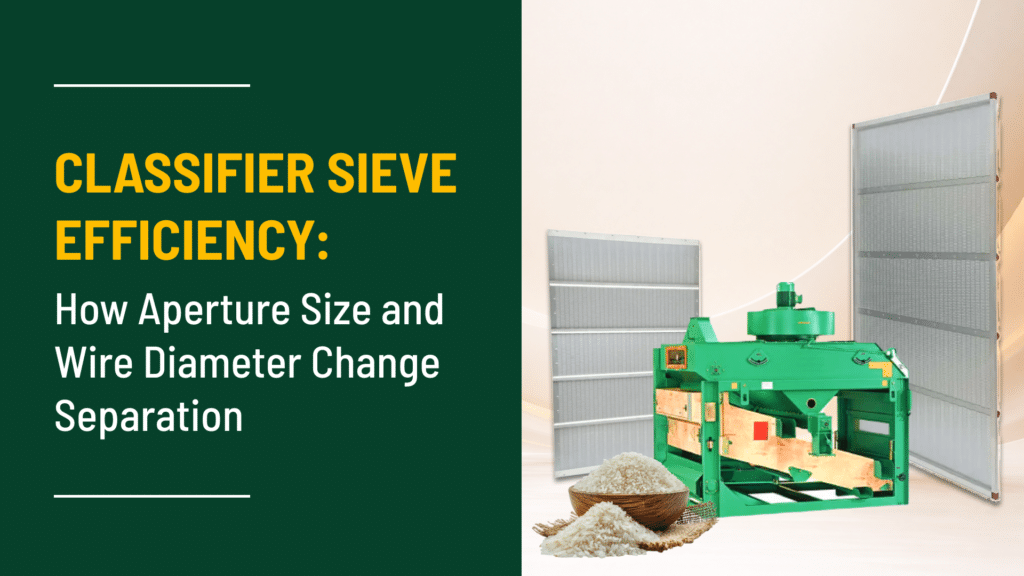
In a grain or seed cleaning line, the classifier sieve is one of the surfaces that most affects product quality. Aperture size, wire diameter, open area, frame condition and installation accuracy all decide how product moves across the deck. When they match the grain and the machine setting, separation is clean and repeatable. When they do not, the plant sees oversize carryover, unwanted fines, blocked openings and unstable output.
If you are looking for a Classifier sieves manufacturer in indore, the useful question is not only whether a sieve fits the frame, but whether its design suits your product, target size range, feed rate and operating conditions. This guide explains how aperture size and wire diameter influence efficiency, and what to check before you order a replacement. DhanlaxmiSales supplies sieves, frames and spares for grain and seed cleaning machines, and you can view the full range of our products.
How a classifier sieve separates grain
A classifier sieve lets particles smaller than the opening pass and holds back larger ones. In practice it works as a probability filter. Long, flat or irregular grains can pass an opening that looks smaller than their longest dimension if they line up the right way, while a rounded grain may bridge or stick and fail to pass.
Feed depth, vibration, slope and surface cleanliness all change the chance of passage. Aperture and wire diameter set the starting geometry, but machine operation decides how well that geometry is used.
How aperture size affects separation
Aperture size defines the nominal cut point. A smaller opening retains more material and gives a finer classification. A larger opening raises capacity but can increase oversize carryover when the feed contains grain close to the size limit.
Choosing an aperture from the grain name alone is risky, because moisture, variety, length, thickness and broken percentage vary from lot to lot. Define the objective first: removing broken grain, separating whole kernels from undersize, grading by thickness, or removing foreign particles. A good Classifier sieves manufacturer in Indore will ask about the target fraction and the machine before suggesting a replacement.
The role of wire diameter and open area
Wire diameter affects both durability and open area. For the same nominal aperture, thicker wire leaves less open area, which can reduce throughput but improves strength and wear resistance. Thinner wire gives more open area but is less resistant to impact, abrasion and loss of tension.
Open area is the share of the surface available for particles to pass. If it is too low, product builds up, the bed gets deeper and correctly sized grain leaves with the oversize. If it is raised without enough support, the sieve can flex or deform and change the aperture. The right balance depends on the grain, vibration level, support under the sieve, cleaning method and operating hours.
Aperture shape and particle orientation
Round, square and slotted openings behave differently. Slots suit separation by width or thickness of elongated grain, but a long particle can still pass if its narrow side aligns with the slot. Square openings give a more balanced classification, yet the result still depends on orientation and product condition. Choose the opening that matches the dimension that matters in your process.
Pre-cleaner sieves and the upstream stage
Classifier performance also depends on what reaches it. Coarse trash, dust and light impurities should be removed early so the classifier can focus on size grading. As a Pre Cleaner sieves manufacturer in indore, Dhanlaxmi Sales offers pre-cleaner and fine-cleaner sieves. sampler sieves are also available.
You can see our classifier sieves (MTRA) page for the classifier range.
Interaction with vibration, feed rate and moisture
Aperture and wire diameter cannot be judged apart from how the machine runs. Weak vibration leaves a thick layer that does not stratify, while aggressive vibration moves grain across too quickly. An overloaded sieve develops a deep bed that blocks access to the openings, even if the open area is high. After changing the sieve, review feed distribution, deck angle and vibration, because a new aperture may need a new operating window.
Moisture and dust cause blinding, where particles block the openings and the sieve behaves as if its open area were much smaller. Inspect regularly for blocked openings, packed material, bent wires and uneven wear, and clean with methods that do not damage the wire or frame.
Frame selection and fit
A good sieve still performs badly in a damaged or unsuitable frame. The frame must hold the sieve evenly, keep tension where required and stop product bypassing the edges. Loose fasteners, warped supports or wrong dimensions let grain avoid the separation surface.
If you are looking for a Classifier PP Frames manufacturer in Indore, explore the Classifier PP Frames (MTRA) range. For Classifier Wooden Frames manufacturer in Indore requirements, you can explore Classifier Wooden Frames MTRA and Classifier Wooden Frames MTRB. Regardless of the frame you choose, consider factors such as rigidity, dimensional accuracy, clamping quality, and compatibility with your specific machine to ensure reliable performance.
Wear and change in effective aperture
Wear gradually changes the cut point. Wires thin out, openings enlarge and tension weakens, which can raise oversize passage without any visible breakage. Record the installation date, product handled, operating hours and cleaning frequency for each sieve, and compare samples from the accepted and rejected streams. If separation gets less precise while settings are unchanged, inspect the sieve first. Replace on performance, not only on visible damage.
Related deck spares: destoner wire mesh
The same selection logic applies to the deck of a vibro destoner, where open area, wire diameter and frame fit affect air flow and stone separation. Buyers searching for a Vibro Destoner wire mesh manufacturer in indore can see our vibro destoner complete wooden frames and shifter frames with SS wiremesh.
Practical checklist before ordering
- Machine model, deck position and frame dimensions.
- Existing aperture, opening shape, material and wire diameter or thickness.
- Product handled and the separation target.
- Symptoms such as carryover, fines, blocking or reprocessing.
- Photographs and, if possible, a sample of the existing sieve.
Ask how the proposed design changes open area, capacity and durability. If a thicker wire is proposed, ask whether the feed rate needs adjustment. After fitting, measure throughput, accepted-product quality and rejected-product contamination.
Conclusion: match geometry to the real process
Aperture size sets the intended separation range, and wire diameter shapes open area, strength and wear. Neither should be chosen alone. The best results come from matching sieve geometry to particle size, moisture, feed rate, vibration, frame support and maintenance routine.
Dhanlaxmi Sales supplies sieves, frames and spares for grain and seed cleaning lines from Indore. Learn more on our about us page, read more on our blogs page, or visit the Dhanlaxmi Sales home page. To discuss your sieve or frame requirement, please contact us with your machine and product details.
Contact Information
Phone Number
+91-6260846795
Whatsapp Number
+91-6260846795
Email ID
info@dhanlaxmisales.com
Address
KHASRA NO. 219/3, PIPLIYAHANA, INDORE, M.P – 452016, INDIA